

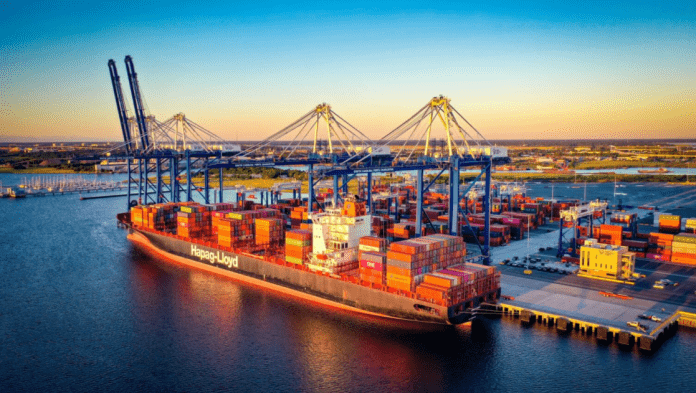
Hapag-Lloyd, the German shipping company, has finalized agreements with two leading Chinese shipyards for the construction of 24 advanced containerships, with a total investment of approximately USD 4 billion.
This significant order comprises 12 vessels from Yangzijiang Shipbuilding Group, each designed to accommodate 16,800 TEU, and 12 vessels from New Times Shipbuilding Company Ltd., each with a capacity of 9,200 TEU.
In alignment with Hapag-Lloyd's Strategy 2030, the new vessels will be outfitted with high-pressure liquefied gas dual-fuel engines capable of operating on biomethane, which can achieve up to a 95% reduction in CO2e emissions compared to traditional engines.
The vessels will be designed to be ammonia-ready, representing a significant advancement in Hapag-Lloyd's pursuit of its ambitious carbon neutrality objectives. CEO Rolf Habben Jansen stated, "Operating a fleet of more efficient vessels will enhance our competitive position, enabling us to provide a high-quality global product."
Scheduled for delivery between 2027 and 2029, the 24 new vessels will collectively provide a capacity of 312,000 TEU, replacing older ships that are approaching the end of their operational lifespan. With $3 billion in long-term financing already secured, this substantial fleet modernization, in conjunction with the recent retrofitting of five vessels for methanol propulsion, underscores Hapag-Lloyd's commitment to a multi-fuel strategy in shipping and its adherence to the Paris Agreement's 1.5-degree target. The company aims to achieve a one-third reduction in greenhouse gas emissions by 2030 compared to 2022 levels, with a long-term goal of reaching net-zero emissions by 2045.
This order from Hapag-Lloyd coincides with the upcoming launch of the Gemini Cooperation with Maersk in February. This alliance will implement a hub-and-spoke strategy across seven trade lanes, targeting a service reliability rate of 90%, which represents a notable enhancement over the current industry average of 53%.