

According to the Maritime Outlook 2025 report published by Xeneta, 2025 is likely to be another challenging year for the ocean container shipping industry. “If 2024 was a year framed by conflict in the Red Sea, expect more of the same, as there is no sign of a political solution that will allow container ships to return to the region on a large scale. This will only exacerbate the dangers for the container shipping industry as there are few gaps in the system to cope with another supply chain shock”.Xeneta's Maritime Outlook 2025 clearly identifies the impact of the diversion from the periphery of Africa on demand for TEU-miles and available capacity in the market. New deliveries and slowing TEU volume growth will ease some of the burden, but not enough to mitigate another major incident. “Will we see an escalation of military conflict in the Taiwan Strait? Will regime change in Bangladesh trigger further unrest? Will the situation in the Middle East deteriorate to the point of affecting shipping in the Persian Gulf? The red lights on the geopolitical dashboard are flashing and it would be foolish to ignore them.”
Xeneta's global average spot price has fallen back since peaking in July as the long-term market begins to rise. “The narrowing of the long and short-term markets will be significant until new long-term contracts are negotiated in 2025. Shippers want the market to narrow further, while carriers are doing their best to keep the spot market high.”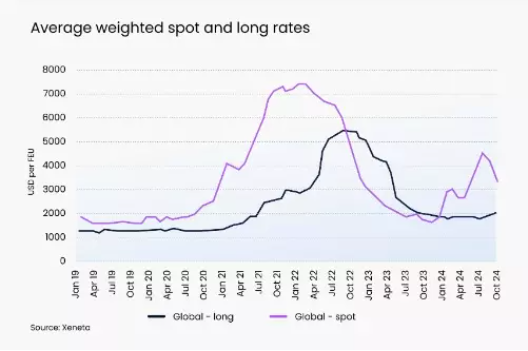
Factors to watch in 2025 Demand is likely to grow by 3% in 2025, while total demand growth in 2024 is expected to be 4-5% and top 180 million TEUs.“Massive demand growth from China to Mexico is expected to continue, with headline inflation staying above the 2% threshold set by the ECB and the Federal Reserve”.2024 has been a year of concern for China-Mexico trade, with demand for TEUs up 22.1% year-to-date compared to 2023.This follows a 34.6% year-on-year increase for the whole of 2023. “One of the key reasons for this is the cooling of US-China relations, with Mexico seen as a backdoor for avoiding import tariffs.
Looking ahead to 2025, demand for this trade is expected to grow further.Another area of concern is the China to Middle East route, which has seen a 52% increase in volumes over 2021. xeneta principal analyst Peter Sand said: “Macroeconomic developments set the overall direction of container shipping demand, but they don't tell the whole story, and shippers need to be aware of the nuances of the market between regions and ports.The upcoming U.S. presidential election will have a significant impact in 2025, as new tariffs may be imposed on Chinese imports, which could cause shippers to revisit their manufacturing and supply chain setups - perhaps further accelerating imports to Mexico.“In 2024, in addition to longer voyages, cargo forwarding is a major driver. Any change in this approach next year poses a downside risk to demand - unless things get even more dramatic in 2025.
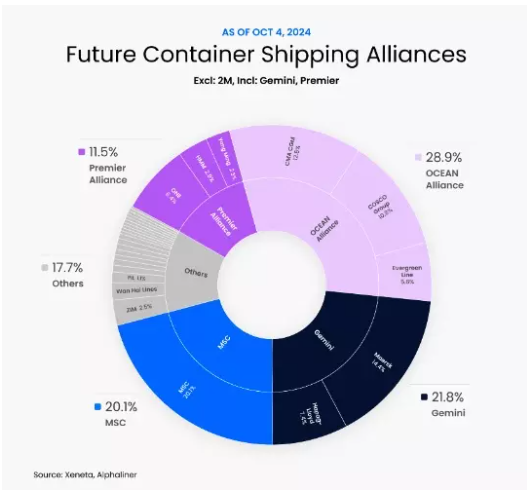
Sand adds: “Shippers must be aware of what the new alliance offers on the routes they use, and this goes far beyond price.It requires a balance between cost, reliability and transit time, while also realizing that the carriers currently used may not be the best carriers for the future.Keep your options open, don't be afraid to challenge carriers and seek assurances that they can deliver on their promises, especially when it comes to service reliability.The report says 2024 will be a bruising year for shippers, who will hope for some relief in 2025, but it's important to be realistic and prepare for further disruption.