

The dry bulk market has been a mixed bag in terms of performance over the past few weeks, although it should be said that the start of the second quarter of 2022 has been positive so far. In its latest weekly report, shipbroker Allied Shipbroking noted that “the dry bulk sector continued on its bullish course, having started the 2nd quarter of the year on a relatively positive tone. On the other hand, signs of uncertainty and volatility are still prevalent in global markets, which could rapidly add to downside risk. The crisis in Ukraine has added a fair amount of market “noise”, with potentially unpredictable consequences on global macros. What will happen with commodity prices, interest rates and inflation? In terms of shipping activity, what sort of restructuring will take place in trade flows?”
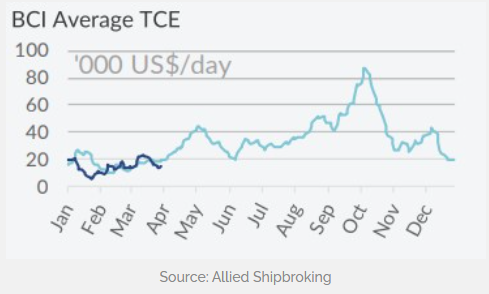
Allied added that “moreover, we should not forget that the Covid-19 pandemic continues, with significant effects taking shape of recent as part of China’s zero case policy. When the forward trend seems blurred and the market lacks stability, albeit still bullish, what kind of strategy looks to be more fitting? Is it possible to maximize short-term potential, without losing the shifting market dynamics and risk targets as well? The basic role of the TSI (True Strength Index) oscillator is to provide early trading signals, by pinpointing shifts in trend direction in the market, whether it be bullish or bearish. However, such an indicator can provide more than just the basic shift in direction”.

According to Mr. Thomas Chasapis, Research Analyst with Allied, “from the graph, we can see that since the start of last year, the Capesize market seemingly “failed” repeatedly to capture the positive momentum and direction seen in the rest of the dry bulk market. Indicatively in the graph, the TSI-BCI line crossed the – 30 bearish line twice, while the rest of the dry bulk segments were on an overall upward track for 3 consecutive quarters. At the same time, an interesting fact is that the TSI-BHSI curve moved in direct contrast to that of BCI during the same time frame. We may well be moving over towards a market regime where diversification, hedging and market strategies can help specific targets be reached via the separate momentum noted between the different dry bulk sub-markets”.
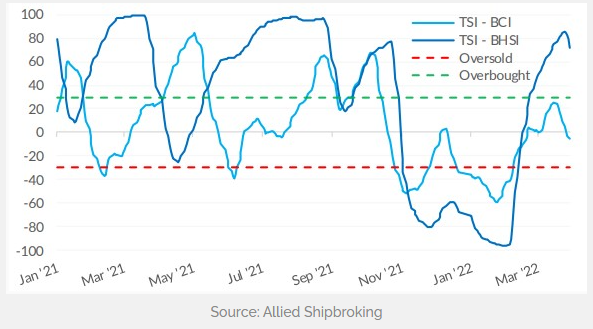
Chasapis added that “the Handysize market presented more volatility according to the TSI metric, but more in line with the overall dry bulk sentiment. Now, the TSI-BCI made a borderline crossover (0 territory), indicating a bearish signal, but the TSI-BHSI has remained in a theoretical overbought condition. This could be an indicator and it could be the case that the contrasting movements between the different sub-markets still hold for interesting plays to be made”, he concluded.
---------- end of report ----------